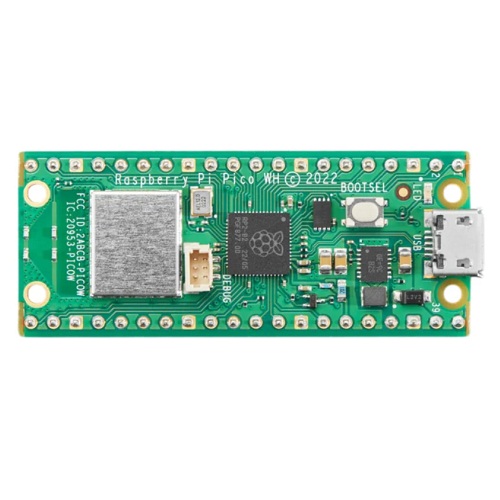
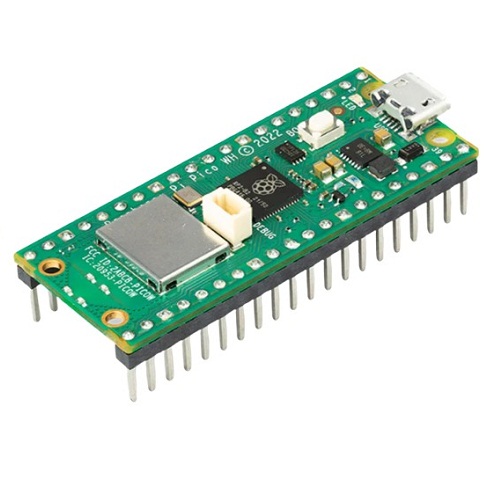
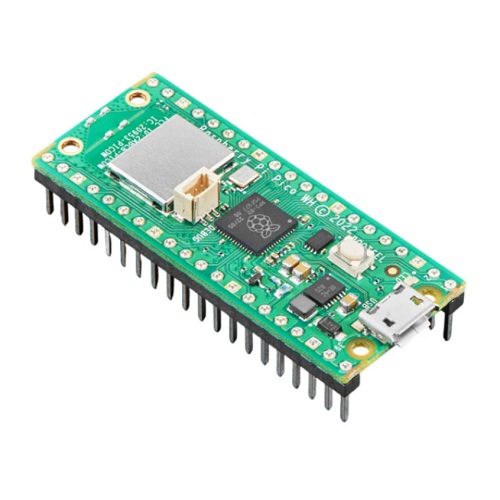
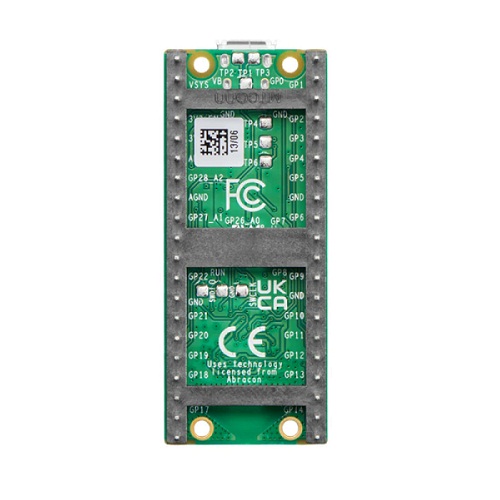
Raspberry Pi Pico WH (Soldered Headers) RP2040 Wi-Fi Development Board (Dual-Core ARM Cortex-M0+ Microcontroller Board)
The Raspberry Pi Pico WH is a compact and powerful microcontroller development board based on the RP2040 dual-core ARM Cortex-M0+ processor with 2MB onboard Flash memory and integrated 2.4GHz Wi-Fi (802.11n) connectivity. Featuring pre-soldered 40-pin headers, it is ready for immediate use with breadboards and development projects. Designed for IoT, embedded systems, robotics, automation, and educational applications, the Pico WH combines excellent processing performance, flexible connectivity, and low power consumption in a compact form factor.
Key Features -
• RP2040 dual-core ARM Cortex-M0+ microcontroller running up to 133MHz
• Integrated 2.4GHz IEEE 802.11n Wi-Fi connectivity
• 2MB onboard Flash memory for program storage
• 264KB high-performance multi-bank SRAM
• Pre-soldered 40-pin GPIO headers for plug-and-play prototyping
• 26 multifunction GPIO pins including 3 ADC-capable pins
• Micro USB Type-B port for programming and power
• Dedicated 3-pin ARM Serial Wire Debug (SWD) interface
• Supports USB, external power supply, or battery operation
• Comprehensive SDK with support for C/C++ and MicroPython development
Specifications -
• Product Type - Microcontroller Development Board
• Model - Raspberry Pi Pico WH (Soldered Headers)
• Microcontroller - RP2040
• CPU - Dual-core ARM Cortex-M0+
• Maximum Clock Speed - 133MHz
• Flash Memory - 2MB
• SRAM - 264KB Multi-bank SRAM
• Wireless Connectivity - 2.4GHz IEEE 802.11n Wi-Fi
• USB Interface - Micro USB Type-B
• GPIO Pins - 26 Multifunction GPIO (3.3V Logic)
• Analog Inputs - 3 ADC-capable GPIO Pins
• Digital GPIO - 23 Digital-only GPIO Pins
• Debug Interface - 3-pin ARM Serial Wire Debug (SWD)
• PCB Dimensions - 21mm × 51mm × 1mm
• Mounting Type - Through Hole / Surface Mount Compatible
• Header Type - Pre-Soldered Male Headers
• Power Supply - USB, External Supply, or Battery
Applications -
• Internet of Things (IoT) devices
• Wireless sensor networks
• Home automation systems
• Robotics and automation projects
• Embedded system development
• Industrial monitoring and control
• Data acquisition and logging
• Smart electronic devices
• Educational and STEM projects